Can Asherman's Syndrome Cause Weight Gain?
This article is for general informational purposes only and is not a substitute for professional medical advice, diagnosis, or treatment. Always consult a qualified doctor about your specific symptoms and test results.
No, not directly. Asherman's syndrome is a condition of the uterus, and current medical understanding doesn't list weight gain as one of its recognized symptoms.
That's not the end of the story, though. A lot of women searching this question are dealing with real, unexplained weight changes alongside a diagnosis, and wondering if the two are connected.
This piece looks at what Asherman's syndrome actually does to the body, why weight gain usually points somewhere else, and when it's worth getting checked separately.
Can Asherman's Syndrome Cause Weight Gain?
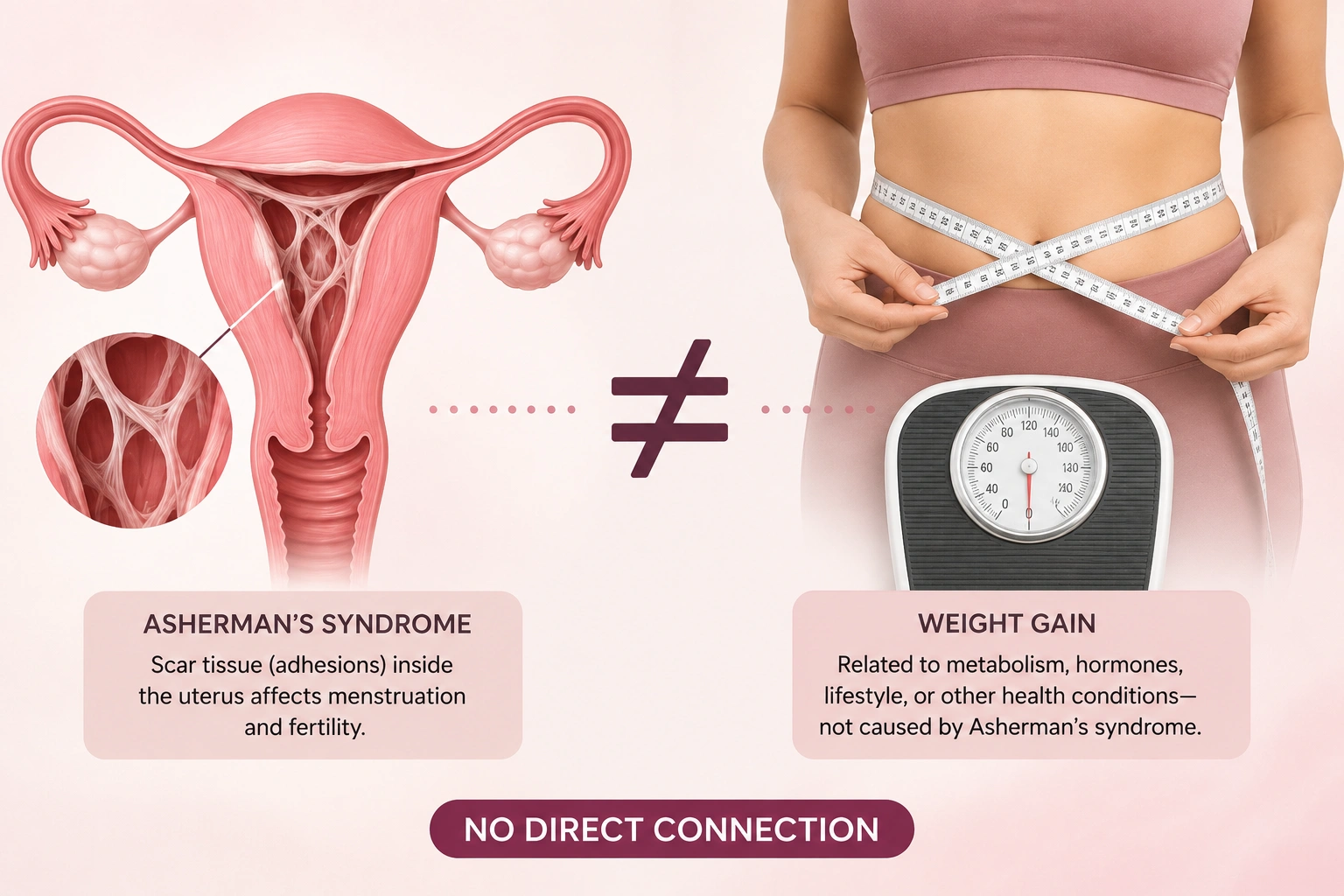
No. Asherman's syndrome involves scar tissue forming inside the uterine cavity, and its effects are largely confined to menstruation and fertility, not body weight or metabolism.
There's no established mechanism linking intrauterine adhesions to fat storage, appetite, or metabolic rate. The uterus doesn't regulate weight the way the thyroid or pancreas does.
That said, some women do notice weight changes around the same time they're diagnosed. Usually that's coincidence, or it's a separate condition that happens to overlap in timing. The likely reasons are covered further down.
Is Weight Gain a Typical Symptom of Asherman's Syndrome?
Not typically, no. The symptoms most consistently tied to Asherman's syndrome are menstrual and reproductive in nature.
These commonly include:
- Lighter periods than usual, or periods that stop altogether
- Pelvic pain or cramping without a period to explain it
- Difficulty getting pregnant
- Repeated miscarriage
Weight gain doesn't appear on standard symptom lists from major gynecology references. If it's happening, it's worth treating as its own question rather than assuming it's part of the Asherman's picture.
What Is Asherman's Syndrome?
Asherman's syndrome happens when scar tissue, sometimes called adhesions, forms inside the uterine cavity. The walls of the uterus can partially or fully stick together.
It's most often caused by trauma to the uterine lining. Dilation and curettage (D&C) procedures, especially after a miscarriage or delivery, are the most common trigger. Uterine surgery and severe infections can also cause it.
The scar tissue interferes with the normal shedding and rebuilding of the uterine lining each cycle. That's why the main effects show up in menstruation and fertility, not in the rest of the body.
Asherman's Syndrome and Weight Changes: Is There a Connection?
There's a difference between a condition causing something directly and two things simply happening around the same time. With Asherman's syndrome and weight gain, it's almost always the second.
Direct causation would mean the adhesions themselves trigger a biological process that leads to weight gain. There's no current evidence for that.
Indirect association is more plausible. Someone recovering from a related procedure, dealing with fertility stress, or managing a separate hormonal condition might gain weight for reasons that have nothing to do with the scar tissue itself.
If weight gain and an Asherman's diagnosis show up together, it's reasonable to look for a separate explanation rather than assume one caused the other.
Can Hormonal Changes Cause Weight Gain With Asherman's Syndrome?
Asherman's syndrome is a structural condition. It's about physical scarring inside the uterus, not a disorder of the hormone-producing glands.
In most cases, the ovaries keep functioning normally, and hormone levels like estrogen and progesterone stay within typical ranges. That's actually part of how doctors distinguish Asherman's syndrome from conditions like premature ovarian insufficiency, where a missed period comes with real hormonal shifts.
This matters for the weight question. Conditions that genuinely drive weight gain, like hypothyroidism or PCOS, do so through measurable hormonal or metabolic changes. Asherman's syndrome, on its own, generally doesn't produce those changes.
Asherman's Syndrome, Bloating and Abdominal Changes
Bloating and weight gain get lumped together a lot, but they're not the same thing, and the distinction matters here.
Bloating is a feeling of fullness or tightness in the abdomen, often from gas, fluid, or hormonal fluctuation. It can make clothes feel tighter for a day or two without any actual increase in body fat.
Some women with Asherman's syndrome report cyclical pelvic discomfort or a bloated sensation, particularly if menstrual blood is partially trapped due to adhesions. That's a mechanical issue related to blocked flow, not the same as gaining weight.
Actual weight gain, by contrast, is a measurable increase in body mass over time, usually from fat or fluid accumulation unrelated to the menstrual cycle. If the scale keeps climbing over weeks or months, that's a different conversation than short-term bloating.
Why Might Someone Gain Weight With Asherman's Syndrome?
If weight gain is happening alongside an Asherman's diagnosis, a few unrelated factors are usually more likely explanations than the condition itself.
- Reduced physical activity. Pelvic pain, fatigue, or recovery from a related procedure can lower activity levels for a while, which affects weight over time.
- Medications. Some hormonal treatments used around uterine procedures, or medications for unrelated conditions, list weight gain as a side effect.
- Pregnancy or postpartum changes. Since Asherman's syndrome often follows a D&C after miscarriage or delivery, the timing can overlap with normal postpartum weight retention.
- Thyroid disorders. Hypothyroidism is a well-documented cause of weight gain and can occur independently of any uterine condition.
- PCOS. Polycystic ovary syndrome is linked to insulin resistance and weight gain, and it's unrelated to intrauterine scarring, though both can affect fertility.
- Perimenopause or menopause. Hormonal shifts during this transition commonly bring weight changes, especially around the abdomen.
- General lifestyle shifts. Stress eating, sleep changes, or a slower routine during a difficult fertility journey can all contribute, quietly, over months.
None of these are automatic. They're possibilities worth ruling in or out with a doctor, not assumptions to make on your own.
Can Asherman's Syndrome Affect Metabolism?
There's no solid evidence that intrauterine adhesions affect metabolic rate. Metabolism is governed mainly by the thyroid, muscle mass, age, and activity level, systems that Asherman's syndrome doesn't directly touch.
Research on Asherman's syndrome has focused almost entirely on fertility outcomes, menstrual patterns, and pregnancy complications. Metabolic effects simply haven't turned up as a finding in the literature.
If someone notices signs of a slower metabolism, like persistent fatigue alongside weight gain, that combination is worth mentioning to a doctor as a separate concern, possibly pointing toward a thyroid check.
Weight Gain After Asherman's Syndrome Treatment
Treatment for Asherman's syndrome usually involves hysteroscopic adhesiolysis, a minimally invasive procedure to remove the scar tissue. It's not a treatment associated with weight gain on its own.
Any weight change noticed afterward is more likely tied to something else happening around the same time.
Post-surgical recovery can mean less movement for a week or two. Hormonal medications sometimes prescribed after the procedure, to support the uterine lining, may carry their own side effects. And if the treatment leads to a successful pregnancy, that's its own separate cause of weight change entirely.
It's worth mentioning any new weight gain to the treating doctor rather than assuming it's an expected part of recovery.
When Should Unexplained Weight Gain Be Evaluated?
Weight gain that's gradual and tied to an obvious cause, like reduced activity during recovery, usually isn't urgent. Weight gain that's sudden, significant, or unexplained is a different matter.
It's worth getting evaluated if:
- Weight gain happens quickly, over a few weeks rather than months
- It's paired with fatigue, hair changes, or cold intolerance
- Periods have become irregular alongside the weight change
- There's swelling in the face, hands, or legs that doesn't go away
A doctor can check thyroid function, blood sugar, and other hormone levels to identify what's actually driving the change.
What Other Symptoms of Asherman's Syndrome Should You Watch For?
Not every woman with Asherman's syndrome experiences the same symptoms, and severity varies a lot depending on how much scar tissue has formed.
Commonly reported signs include lighter periods, or periods that stop entirely in more severe cases. Some women experience painful cramping without a period, caused by trapped menstrual blood behind adhesions.
Fertility struggles are common, including difficulty conceiving and a higher rate of miscarriage. Anyone facing ongoing fertility difficulty may want to look at what infertility treatment in India typically involves, since evaluation and treatment options often overlap with what's used for Asherman's-related infertility. In pregnancies that do occur, there's also a higher risk of complications like abnormal placental attachment.
These symptoms won't all appear in every case. Mild adhesions sometimes cause no noticeable symptoms at all, and get discovered only during a fertility workup.
How Is Asherman's Syndrome Diagnosed?
Diagnosis typically starts with a discussion of menstrual history and any past uterine procedures, since D&C and similar surgeries are the most common trigger.
From there, doctors generally use imaging or direct visualization to confirm adhesions. A saline infusion sonogram, hysterosalpingogram, or diagnostic hysteroscopy are the most common tools, with hysteroscopy considered the most definitive.
This isn't something to self-diagnose from symptoms alone. Light periods and fertility difficulties have many possible causes, and proper diagnosis needs direct examination of the uterine cavity.
When Should You Speak With a Doctor?
A gynecologist or reproductive health specialist should be involved if periods become noticeably lighter or stop after a uterine procedure, if pregnancy attempts aren't succeeding after several months, or if there's a history of repeated miscarriage. HealthRoop's specialties page lists the range of gynecology and fertility specialists available for this kind of evaluation.
Weight gain on its own, without any menstrual changes, is a reasonable enough reason to see a doctor too, just not necessarily the same specialist. A general physician or endocrinologist may be the better first stop for that specific concern.
Bringing both concerns to a doctor at once, rather than assuming they're connected, tends to lead to faster, more accurate answers.
How HealthRoop Supports You
Women exploring treatment options for Asherman's syndrome, including international care, can reach out to HealthRoop for help connecting with reproductive health specialists and understanding available treatment pathways.
Support typically covers:
- Free medical report and scan review
- Hospital and specialist matching based on the case
- Transparent cost estimate in USD and INR
- Second opinion, if needed
- Medical visa assistance, including FRRO or visa extension support
- Travel and accommodation planning, plus currency exchange and local SIM help
- Airport pickup on arrival
- Interpreter support during consultations
- A dedicated case manager from first review through discharge
- Telemedicine follow-up and 24x7 emergency support after treatment
Anyone weighing treatment for Asherman's syndrome in India can reach out to HealthRoop and start with a report review before booking anything. Learn more at healthroop.com.
This article is for general information and isn't a substitute for personal medical advice. Anyone experiencing symptoms of Asherman's syndrome, or unexplained weight changes, should speak with a qualified doctor for proper evaluation.
Frequently Asked Questions
Answers on Asherman's syndrome, weight gain, and when to see a doctor.
No direct link is established in current medical evidence. Weight gain occurring alongside the condition is usually explained by something separate.
It's not on standard symptom lists. The recognized symptoms are mainly menstrual and reproductive.
Not directly. Unexplained weight gain deserves its own evaluation, since it may point to a thyroid issue, PCOS, or another condition.
Some women report pelvic bloating or discomfort, sometimes related to trapped menstrual blood. That's different from an actual increase in body weight.
Generally not. It's a structural condition of the uterus, and ovarian hormone production is usually unaffected.
It's not a typical outcome of the procedure itself. Related factors like reduced activity during recovery or medication side effects are more likely explanations.
There's no established evidence that it does. Metabolism-related symptoms are worth checking separately, often starting with thyroid function.
Hypothyroidism, PCOS, perimenopause, certain medications, and reduced physical activity are among the more common causes.
Yes. Lighter or absent periods, difficulty conceiving, and higher miscarriage risk are among its most recognized effects.
If it's rapid, significant, or paired with symptoms like fatigue or irregular periods, it's worth getting evaluated rather than waiting it out.
